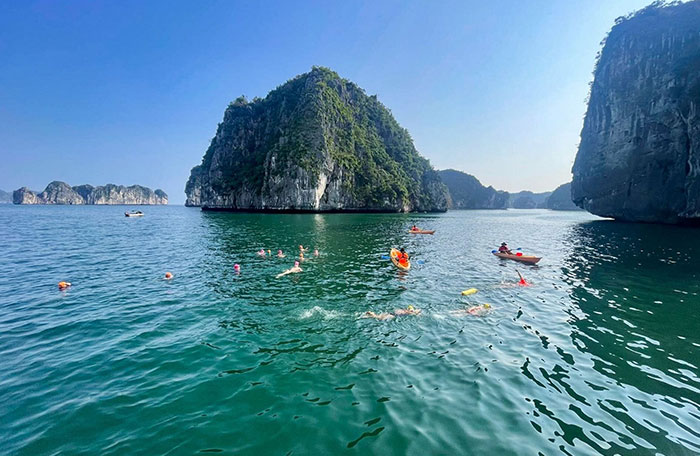
Halong Bay is famous around the world for its emerald waters, towering limestone islands, mysterious caves, and dramatic seascapes. Yet beneath this spectacular scenery lies a fascinating geological story that has unfolded over millions of years.
The landscape of Halong Bay is not simply a collection of beautiful islands. It is the result of powerful natural processes involving limestone formation, erosion, tectonic movements, changing sea levels, rainfall, tides, and weathering. These forces continue to shape the bay today, which is why its appearance can feel subtly different from one visit to another.
For travelers exploring this remarkable destination, a halong nostalgia cruise offers an opportunity to experience these geological wonders from the water while discovering the natural forces that created them.
How Halong Bay Was Formed
The foundation of Halong Bay’s landscape is limestone. Much of this limestone developed from marine sediments that accumulated in ancient seas over geological time.
As geological conditions changed, layers of sediment were compressed and transformed into solid limestone. Later tectonic movements gradually shaped the region, lifting and fracturing the limestone formations.
Over millions of years, these rocks were exposed to rainwater, seawater, wind, and other natural forces. The result was the distinctive karst landscape that defines Halong Bay today.
The hundreds of limestone islands and islets are therefore not random geological formations. Each one represents part of a much longer natural history.
The Role of Erosion in Shaping the Islands
One of the most important scientific processes behind Halong Bay’s appearance is erosion.
Rainwater naturally absorbs carbon dioxide from the atmosphere and soil, becoming slightly acidic. When this water enters cracks and pores within limestone, it can gradually dissolve the rock.
Over extremely long periods, this process enlarges cracks, creates cavities, and contributes to the formation of caves and unusual rock structures.
At the same time, waves and tides continuously interact with the lower sections of the limestone islands. Coastal erosion can create cliffs, arches, and other distinctive formations.
This combination of chemical weathering and physical erosion helps explain why Halong Bay contains such a remarkable variety of geological shapes.
Why the Limestone Islands Look So Different
Visitors often notice that no two islands in Halong Bay appear exactly alike.
Some formations rise dramatically from the sea with steep vertical walls. Others have rounded surfaces covered by vegetation. Some contain caves, while others display unusual openings or natural arches.
These differences are partly explained by variations in the composition, structure, and fracture patterns of the limestone.
Areas with more cracks can allow water to penetrate deeper into the rock. Over time, these weaknesses become pathways for erosion.
Vegetation also contributes to the process. Plant roots can enter small cracks and gradually widen them, while soil and organic material can influence the chemical weathering of the limestone.
The result is a constantly evolving landscape rather than a static collection of islands.
Caves: Geological Time Capsules
The caves of Halong Bay provide another fascinating insight into the region’s geological history.
Cave systems can develop when water moves through fractures in soluble limestone. As the rock slowly dissolves, underground cavities become larger and more complex.
Some caves contain stalactites and stalagmites formed through the gradual deposition of minerals from dripping water.
These formations can take extremely long periods to develop, making caves valuable records of environmental and geological change.
Exploring a cave during a halong nostalgia cruise therefore offers more than a sightseeing experience. It is also an opportunity to see evidence of natural processes that have operated for thousands or even millions of years.
The Influence of Sea-Level Changes
Another major factor behind Halong Bay’s landscape is changing sea level.
Throughout geological history, global sea levels have risen and fallen because of changes in climate, ice volume, and other natural factors.
When sea levels changed, previously exposed limestone landscapes could become submerged. Over time, valleys and depressions were flooded, leaving isolated limestone towers surrounded by water.
This helps explain the characteristic appearance of Halong Bay: tall karst formations rising directly from the sea.
The relationship between limestone terrain and changing sea levels is one of the key reasons the bay looks so different from many other coastal landscapes.
Tides and Waves Are Still Working Today
The geological story of Halong Bay did not stop when its current landscape emerged.
Tides continue to move seawater through the bay, while waves interact with the shoreline and limestone formations. Although these processes may appear insignificant during a single cruise, their cumulative effects become substantial over geological timescales.
This is an important concept when looking at Halong Bay. The landscape may appear permanent, but it is actually part of a much longer cycle of erosion and transformation.
A cliff that looks unchanged today may be subtly different thousands of years from now.
Weather and Seasonal Changes
The geology of Halong Bay is also closely connected to weather.
Rainfall influences the chemical weathering of limestone, while sunlight, humidity, wind, and temperature affect the surrounding ecosystem and appearance of the islands.
Seasonal conditions can dramatically change how the landscape is perceived.
On a clear day, distant limestone formations may appear sharply defined against the horizon. On humid or misty mornings, the same islands can appear softer and more mysterious.
This is one reason travelers can return to Halong Bay several times and still feel as though they are seeing a different destination.
The Living Ecosystem Around the Limestone Karst
The limestone landscape does not exist independently of life.
Halong Bay supports marine ecosystems and vegetation adapted to its rocky islands and coastal environment. Trees and plants grow on many limestone formations, while marine organisms inhabit the surrounding waters.
The interaction between geology and biology is particularly interesting.
Plants can establish themselves in cracks and pockets of soil on the limestone. Their roots contribute to weathering, while the vegetation itself helps create habitats for insects, birds, and other organisms.
In this sense, Halong Bay is not merely a geological landscape. It is a dynamic ecosystem where rock, water, climate, and living organisms interact continuously.
Why the Landscape Looks Different From a Cruise
One of the best ways to appreciate Halong Bay’s geological structure is from the water.
From a cruise deck, the perspective constantly changes as the vessel moves between limestone islands. Formations that initially appear close together can reveal surprising distances and different shapes as the viewpoint changes.
A halong nostalgia cruise allows travelers to experience this constantly shifting perspective at a relaxed pace.
Instead of viewing the bay from a single fixed location, passengers gradually move through its geological landscape, observing cliffs, islands, caves, beaches, and channels from different angles.
This makes the science behind the scenery easier to appreciate.
Halong Bay Is a Landscape in Motion
The most fascinating lesson from Halong Bay’s geology is that landscapes are never truly static.
The limestone formations we see today are the product of extremely long periods of geological change. Rainwater continues to interact with the rocks. Waves continue to shape the coast. Tides continue to move through the channels, while vegetation and marine life continue to influence their environment.
These processes are generally too slow to notice during a single journey. But when viewed across geological time, they reveal a landscape that is constantly evolving.
Halong Bay’s beauty therefore comes not only from what exists today, but also from the natural forces that created it.
Experience the Science and Beauty of Halong Bay
Understanding the geology of Halong Bay adds another dimension to a cruise through this iconic Vietnamese seascape.
The towering limestone islands, hidden caves, peaceful waters, and mist-covered horizons are all connected to a much larger scientific story involving ancient seas, geological uplift, erosion, weathering, and changing sea levels.
With halong nostalgia cruise, travelers can experience this extraordinary landscape from the water while taking time to appreciate the natural processes behind its creation.
Halong Bay may look timeless, but its landscape is actually part of an ongoing geological journey. Every island, cave, cliff, and channel carries evidence of the powerful forces that have shaped this remarkable corner of Vietnam.
Frequently Asked Questions
How was Halong Bay formed?
Halong Bay was shaped over geological time through the development of limestone formations, tectonic processes, erosion, weathering, and changes in sea level.
Why does Halong Bay have so many limestone islands?
The bay’s distinctive karst landscape developed as soluble limestone was gradually shaped by water and other natural processes, leaving isolated towers and islands surrounded by the sea.
Are the caves in Halong Bay naturally formed?
Yes. Many caves developed through the gradual dissolution and erosion of limestone by water over long periods.
Does Halong Bay’s landscape still change today?
Yes. Erosion, weathering, tides, waves, rainfall, and biological activity continue to influence the landscape, although most changes occur very slowly.
Why is a cruise a good way to explore Halong Bay?
A cruise provides changing viewpoints of the limestone formations, allowing travelers to observe the relationship between the islands, caves, water, and surrounding ecosystem from different perspectives.